
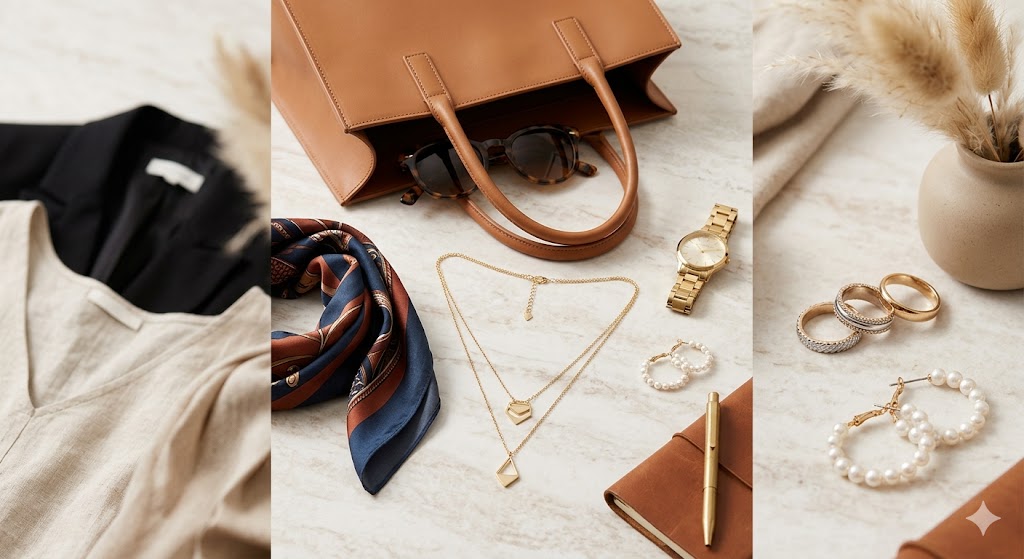
There’s a moment most of us have experienced — you’re standing in front of the mirror, outfit on, and something just feels off. The clothes are fine. The fit is good. But the look isn’t quite landing. Nine times out of ten, it’s not the outfit that needs fixing. It’s the finishing touches.
Knowing how to accessorize outfits is the most underrated tool in your wardrobe. And here’s the thing — learning to use them well isn’t just about fashion. It mirrors one of the most powerful principles in investing: intentionality over volume. You don’t need more. You need the right ones, chosen with purpose and placed with strategy.
Let’s break it down.
I. The Investor’s Mindset — Why Less Is Often More
In the world of investing, throwing money at every opportunity rarely builds lasting wealth. What separates a smart portfolio from a scattered one is curation — knowing what to hold, what to leave behind, and why each piece earns its place.
Accessorizing works exactly the same way.
When you pile on every necklace, ring, bracelet, and bag you own, the result isn’t abundance — it’s noise. Your eye doesn’t know where to look, and the overall impression gets muddled. Contrast that with a single gold cuff, a tailored belt, and a structured bag that ties your whole look together. That’s not simplicity. That’s precision.
This is the first secret most people miss: the goal isn’t to accessorize more. It’s to accessorize better. And just like a well-balanced portfolio, the magic is in how your pieces work together — not how many you own.
Start here: Before you get dressed, decide what role each accessory will play. Is it the statement piece? The subtle complement? The functional anchor? Give every item a job, and you’ll naturally edit out what doesn’t belong.
II. Understanding Balance — The Asset Allocation of Your Outfit
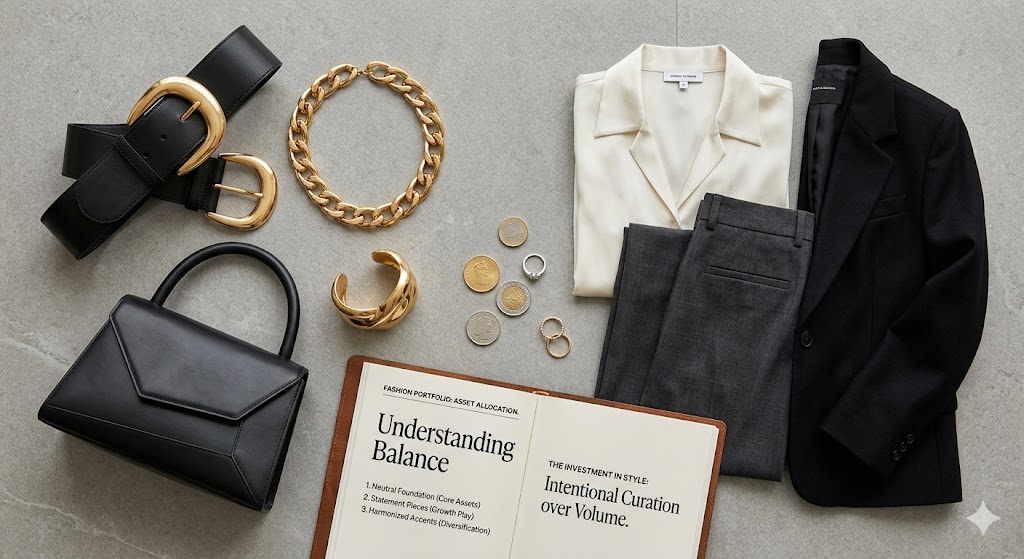
- Match boldness to simplicity. If your outfit already has strong energy — a floral print, a vibrant color block, a textured fabric — your accessories should dial back, not compete. Think of it like asset allocation: when one part of your portfolio is high-risk and high-reward, you balance it with something stable. A neutral outfit is your “safe asset.” Bold accessories are your growth play.
- The harmony rule. Every strong look has a focal point. Your accessories should either support that focal point or create one — never fight against it. A statement earring pair draws the eye upward. A bold belt defines your silhouette and anchors the look downward. Decide what story you want to tell, then let your accessories tell it clearly.
- Avoid over-diversification. In investing, spreading too thin across too many assets can actually reduce your returns. Same with accessories. Stacking three necklaces, two bracelets, a bold ring, oversized earrings, and a patterned scarf all at once doesn’t communicate style — it communicates chaos. Pick your strongest two or three pieces and let them breathe.
III. Jewelry — Your Highest-Return Investment
Jewelry is often where the biggest transformation happens with the least effort. And like any smart investment, the key is knowing what gives you the best return on styling.
3 principles for jewelry that always pays off:
1. Layering with intention. Delicate layered necklaces have a way of adding visual depth without adding weight to your look. The trick is to vary the lengths — a choker, a mid-length pendant, and a longer chain create movement and dimension. Keep the metal tones consistent (all gold or all silver) unless you’re deliberately going for a mixed-metal moment.
2. Skin tone is your secret weapon. This is one of those overlooked details that makes a massive difference. Warm undertones (golden, peachy, olive skin) naturally light up with yellow gold and rose gold. Cool undertones (pink, red, or bluish hues) look striking with silver and white metals. Neutral undertones? You’re the lucky ones — both work beautifully. Leaning into your undertone isn’t a rule you have to follow, but when you do, your jewelry almost glows.
3. Stack smart, not heavy. Rings are having a major moment, and rightly so. A few stacked rings across two or three fingers creates a curated, editorial feel. The key is to vary textures and widths — mix a thin band with a chunkier signet ring, or a plain band with one that has a small stone. The variation is what makes it look intentional rather than cluttered.
IV. Functional Accessories — The Blue Chips of Your Wardrobe
If jewelry is your growth stock, think of functional accessories as your blue chips — reliable, versatile, and quietly powerful.
Handbags are one of the most impactful accessories you own. A structured leather bag can elevate a plain white tee and jeans into something that looks put-together and polished. A crossbody bag keeps things relaxed and hands-free for busy days. The silhouette of your bag changes the energy of your whole outfit, so it’s worth thinking about more than just color.
Belts are criminally underused. A simple leather belt in a neutral tone — black, tan, or cognac — is one of the most versatile accessories you can own. It defines your waist, adds structure, and instantly makes an outfit look finished. Belts also work beautifully over blazers, oversized shirts, and even dresses that feel a little shapeless on their own.
Sunglasses do double duty: they’re functional and stylistic at once. The right frame shape for your face can become as recognizable as a signature. Cat-eye frames feel retro and feminine. Oversized frames read as effortlessly chic. Slim rectangular frames skew modern and cool. Find your frame and own it.
Scarves deserve their own mention because of how many ways they can be worn. Tied loosely around your neck, they add a European, relaxed elegance. Knotted on the handle of your handbag, they add a pop of pattern and color. Worn as a headband, they bring a playful, vintage energy. One scarf, endless possibilities — that’s the definition of a high-return investment.
V. Color Strategy — Knowing When to Play It Safe and When to Take a Risk
5 color principles that experienced stylists (and investors) live by:
- Neutrals are your stable foundation. Black, white, camel, grey, and navy go with almost everything. Build your accessory wardrobe here first.
- One color accent is almost always enough. If your outfit is neutral, one colorful accessory — a cobalt blue bag, a cherry red belt — does far more than three competing ones.
- Metallics count as neutrals. Gold, silver, and bronze are surprisingly versatile and work across seasons and color palettes.
- Pattern mixing is advanced territory. If you’re mixing a patterned scarf with a patterned outfit, make sure at least one color is shared between both patterns.
- Contrast creates energy. Pairing warm tones with cool tones — a rust scarf with a navy blazer, for example — creates a dynamic tension that makes a look feel alive.
VI. The Personal Portfolio — Accessories That Hold Meaning
Here’s where accessorizing stops being about fashion and starts being about identity.
The most compelling looks aren’t built from the most expensive pieces. They’re built from pieces that carry meaning. That bracelet you bought on a trip abroad. The earrings your grandmother passed down to you. The watch you saved up for after landing your first real job. These pieces don’t just complete your outfit — they communicate something true about who you are.
This is the emotional side of investing that financial advisors rarely talk about, but it matters just as much in style. When you wear something that has a story, you carry it differently. You stand taller. You feel more like yourself. And people notice that — not the accessory itself, but the confidence it gives you.
Build your accessory wardrobe the way the best investors build their portfolios: with patience, with purpose, and with a long-term vision. Don’t chase every trend. Invest in pieces that age well, that work across seasons and occasions, and that you’ll still love five years from now.
VII. 6 Quick Rules to Remember
- Let your outfit’s boldness guide your accessory volume.
- Choose one statement piece and let everything else support it.
- Match metal tones to your skin undertone for an instant upgrade.
- Functional accessories — bags, belts, sunglasses — are always worth the investment.
- Scarves are the most underrated multi-use accessory you can own.
- Wear pieces that mean something. Style built on identity always outperforms style built on impulse.
Your Next Step — Start With One Intentional Choice
You don’t need to overhaul your wardrobe or go on a shopping spree to start dressing better. You just need to make one more intentional choice the next time you get dressed.
Look at your outfit. Ask yourself: what does this look need — and what does it not need? Then choose your accessories like a smart investor chooses their assets: with clarity, confidence, and a clear sense of what each piece is there to do.
That’s the real secret to a polished look. Not more. Better.
Ready to elevate your everyday style? Share this article with someone who could use a style reset, and explore more tips on building a wardrobe that works as hard as you do. Your best-dressed era starts with a single intentional step — take it today.
Style isn’t about what you own. It’s about how intentionally you wear it.